cat posts/en/stirb-klug-12-lost-signalisieren.md
Die Smart (Episode 12): Lost—signaling and getting found
Surviving also means getting found. When staying put beats setting off, how mirrors, smoke, light, and ground signals work, and why visibility is part of every rescue strategy.
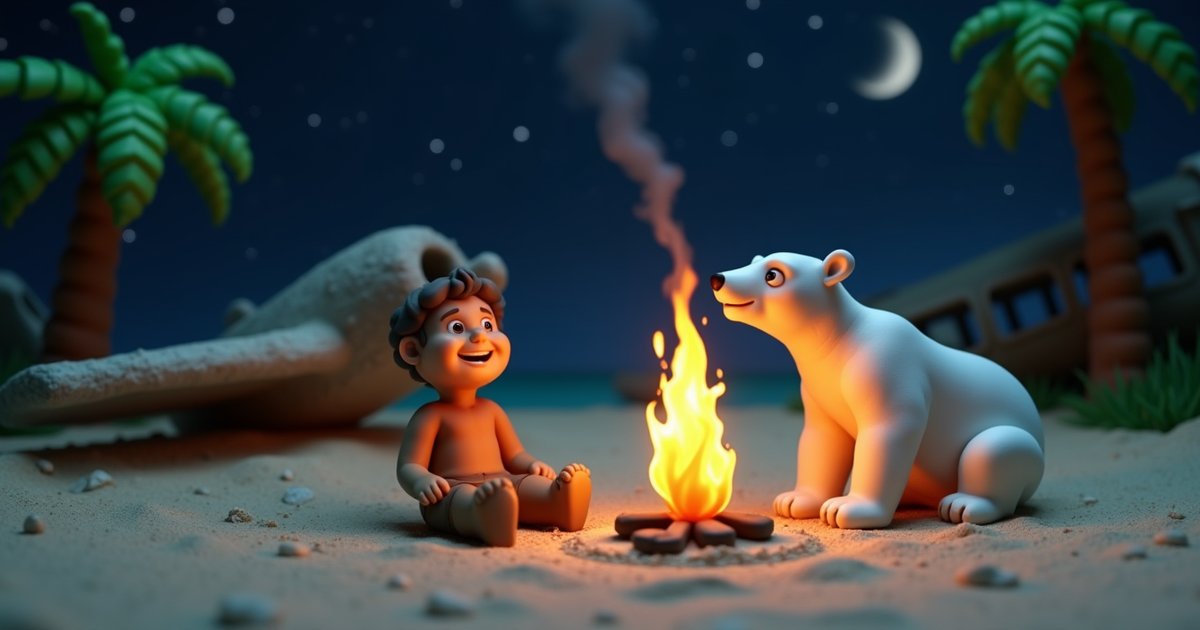
Spoiler warning: General references to the TV series Lost (2004–2010) ahead.
In episode 11, the point was that someone knows where to look for you.
This time, it's the other half:
The searchers also have to spot you.
Lost works pretty well for this. After Oceanic Flight 815 crashes, the survivors are stranded on a remote island. They get immediate survival organized surprisingly fast.
The bigger problem is:
How do we tell the outside world that anyone here needs rescuing at all?
And suddenly a smoking fire becomes more important than the next coconut.
The situation
The survivors actually have a big advantage.
They haven't vanished one by one somewhere in the jungle. At first, they're at the wreck of a crashed airliner on an open beach.
That's a pretty good starting point for a search.
Big wreck.
Lots of people.
A clear view of the sky and the sea.
So a signal fire goes up early.
At the same time, a classic survival debate begins: On the beach, the survivors are visible, but water and shelter are limited. Inland there are caves and fresh water, but no passing plane will see the group there.
Lost turns this into a conflict between two completely legitimate needs:
surviving and getting found.
These two things have to fit together.
Survival check
✓ Staying visible at the wreck and on the beach
Sayid argues early on for staying on the beach and keeping the signal fire going.
From a search and rescue point of view, that's pretty sensible.
After a plane crash, the wreck is a big, unusual landmark that's comparatively easy to see from the air.
A single person under trees, on the other hand, is surprisingly easy to miss.
So if you know people are searching for a crashed plane, don't casually wander off kilometers away from it.
That only holds, of course, as long as the site itself is safe enough and basic needs can still be met there.
✓ Not ignoring water and shelter, though
Jack sees the other side.
The caves offer shelter and a source of fresh water.
He's right too.
There's little point in sitting perfectly visible on the beach and dehydrating there.
So the interesting solution isn't necessarily:
Beach or caves.
But:
Organize supplies where it makes sense—and keep a permanently visible signal point on the beach.
With a group like the one in Lost, that's even relatively easy.
Not everyone has to sit next to the signal fire around the clock.
You can split up the tasks.
✓ Signal fire
A signal fire on an open coast is a sensible classic.
During the day, the main thing is the smoke.
At night, the flame is easier to see.
The point isn't to have a cozy campfire burning somewhere.
It has to stand out from a long way off.
For that, you need:
- an open site,
- enough fuel,
- material for clearly visible smoke,
- someone to tend the signal,
- and a safe fire spot.
Above all, the system should be prepared.
When the plane is already disappearing over the horizon, a messy pile of firewood isn't a signal yet.
✗ Signaling isn't a side job
This is where Lost gets a lot less consistent.
At some point, the characters have other problems.
Lots of other problems.
The island keeps them busy with polar bears, kidnappings, hatches, secret stations, and all sorts of people who clearly have a more complicated weekly schedule than ordinary islanders.
So the rescue strategy inevitably slides down the list.
In a real situation, that would be a mistake.
If a search is realistic, signal readiness is one of the daily chores:
- check the signal site,
- add fuel,
- maintain conspicuous ground signals,
- keep signaling gear within reach,
- regularly watch for planes or ships.
Rescue isn't an event.
It's a job.
🎬 The island doesn't play fair
Of course, Lost has one small advantage over reality:
The island apparently isn't all that keen on being found.
That takes us out of classic search and rescue doctrine.
Current FAA handbooks cover smoke monsters only inadequately.
Stay or go?
The question comes up in almost every survival story.
Do I stay here or go look for help myself?
The popular answer is:
Always stay.
That's too simple as well.
If you're lost
If you no longer know your position for sure, but someone knows your planned route and return time, wandering around is usually a bad idea.
That goes double if a search is already likely.
First, try to:
- stay calm,
- figure out your position with a map, GPS, or landmarks,
- safely retrace your steps to the known route, if that's clearly possible.
If that doesn't work:
stay.
The National Park Service explicitly advises against constantly changing your location, because that makes the search even harder.
Exception:
The spot is an immediate threat to your life.
Then the wildfire obviously takes priority over your neat search strategy.
After an accident or crash
This applies even more to:
- vehicle breakdowns,
- plane crashes,
- capsized boats with a life raft,
- other known accident sites.
A vehicle, wreck, or survival craft is usually much bigger and more conspicuous than you.
And searchers can look for exactly that.
So the better question isn't:
Could I walk somewhere?
But:
Do I have a really good reason to leave the most likely search location?
"Maybe there's something over there" doesn't really count.
When moving can make sense
Staying isn't a religion.
Moving can become necessary if:
- your current location is dangerous,
- you lack water or shelter,
- there definitely won't be a search for this location,
- you know your position,
- you know a realistic, reachable destination.
Then, if possible, leave information behind:
- where you went,
- when you left,
- how many people are with you.
A large arrow as a ground signal can also mark the direction.
Better still: a clearly legible note in a waterproof container at the original location.
That way, a fixed search point at least doesn't turn into a complete dead end.
Signal mirror: tiny, light, and surprisingly effective
One of the best arguments for a signal mirror is:
It doesn't need a battery.
A real survival signal mirror usually has a sighting aid that lets you aim the reflected sunbeam fairly precisely at a plane, helicopter, ship, or distant searchers.
In good conditions, that flash of light is visible over enormous distances.
The FAA reports mirror flashes that were spotted from more than 25 miles away.
That's over 40 kilometers.
Not bad for something that fits in your pocket.
40 kilometers isn't a guarantee
Still, don't turn that number into a new survival law.
How visible you actually are depends on:
- direct sun,
- viewing angle,
- the atmosphere,
- the background,
- the size and quality of the mirror,
- correct aiming,
- how attentive the observer is.
In research on daytime visual distress signals, the US Coast Guard came to an important conclusion:
A mirror needs direct sunlight.
Even light clouds in front of the sun are enough to make the principle fail. Rule of thumb: the mirror only works as long as the sun casts a shadow.
So the signal mirror isn't a "100 km rescue beam."
It's an extremely light signaling device that's very capable in the right conditions.
Using a signal mirror correctly
With a proper signal mirror, you use the built-in sighting aid.
That's far more reliable than:
holding it roughly toward the plane and hoping.
The exact technique depends on the model, and it's best to practice it once before your trip.
The goal is always the same:
Put the small spot of reflected light on the target.
A plane can be very far away.
Even a small angular error makes the flash miss by kilometers.
Improvised mirror
Other reflective objects can work too:
- a small ordinary mirror,
- polished metal,
- shiny parts of your gear.
They're usually harder to aim than a real signal mirror.
An emergency blanket can produce conspicuous reflections, but it isn't a particularly precise substitute.
If you have the choice:
a proper signal mirror.
"Best at noon" isn't quite right
The mirror doesn't work by the clock.
It works by geometry.
You need:
- the sun,
- a reflective surface,
- a target.
A mirror can work excellently in the morning or afternoon too.
At noon, the sun is just in a different position.
So the rule is:
If you see a potential rescuer and you have direct sunlight, signal.
Don't wait until after lunch.
Three is a well-known distress signal
In the outdoors, three repeated signals are a widely used emergency pattern.
For example:
- three whistle blasts,
- three flashes of light,
- three shouts.
Then a pause.
Then repeat.
The advantage is obvious:
A single whistle blast can be a coincidence.
Three identical signals in a recognizable rhythm come across as deliberate.
The National Park Service, for example, also recommends three whistle blasts as a distress signal.
Still, the rule of three isn't a magic alphabet that everyone in the world is guaranteed to understand.
If searchers can see you:
Draw attention to yourself.
Don't stop just because you're only at whistle blast number two.
SOS is less ambiguous
With light signals, you have another well-known option:
SOS
In Morse code:
··· ——— ···
Three short.
Three long.
Three short.
With a flashlight or headlamp, you can send this very clearly at night.
What counts is the recognizable rhythm.
A frantic strobe of random flashes might look more spectacular.
A recognizable message is more helpful.
Smoke by day, light by night
The rule of thumb from episode 6 still makes sense:
During the day, a fire mainly has to make smoke.
At night, it has to glow.
So with a prepared signal fire, when you spot a plane or ship during the day, you can add smoke-producing material to a well-established fire.
Damp green plant material can produce thick, light-colored smoke.
But please don't burn:
- plastics,
- rubber,
- fuel,
- unknown chemicals
just because black smoke looks more impressive.
A rescue signal shouldn't poison your lungs at the same time.
Signal fires and wildfires
On an open, damp coast like the one in Lost, fire is a different calculation than in a bone-dry forest.
When wildfire danger is high or fires are banned, a big signal fire can become an emergency of its own.
That's why the National Park Service explicitly advises against building any fire at all when fire risk is high.
Then other means are better:
- a mirror,
- a whistle,
- light,
- conspicuous clothing,
- ground signals,
- electronic emergency beacons.
The best rescue isn't the one where a firefighting plane then has to fight your signal smoke.
Ground-to-air signals
When a search plane is circling overhead, a large symbol on the ground can pass on information.
For this, the FAA lists an internationally used Ground-Air Visual Code.
For survivors, these symbols are the most relevant:
- V: assistance required
- X: medical assistance required
- N: no
- Y: yes
- ↑: proceeding in this direction
And perhaps the most useful extra rule from the FAA:
If in doubt: SOS.
That beats an exotic symbol you only half remember.
How big do ground signals have to be?
The FAA recommends making the symbols at least 10 feet (a good 3 meters) high.
Bigger is better.
From the ground, a 3-meter V already feels pretty big.
From a plane, it isn't.
So three things are important:
Size, contrast, and a clear shape.
Suitable materials can include:
- dark branches on snow,
- light rocks on dark ground,
- clothing,
- tarps,
- parts of a parachute,
- cleared or trampled areas.
On snow, symbols stamped or shoveled into it can look dark from the air and stand out well as a result.
Where you put the signal counts
A perfect 10-meter SOS under a dense canopy is mostly a lot of
work.
A ground signal needs:
- a clear view of the sky,
- as large an open area as possible,
- strong contrast with the ground.
Being "high up," on the other hand, isn't a strict requirement.
A large open stretch of beach can be much better than a small wooded hilltop.
Search and rescue cares more about visibility than about romance.
The wreck is a signal itself
After a plane crash, you might already have your biggest ground signal:
the plane.
Accordingly, the FAA advises staying with the aircraft after an accident if the situation allows.
At first, searchers aren't looking for a single person in hiking pants.
They're looking for a plane.
The same goes for other large objects:
- a vehicle,
- a boat,
- a life raft,
- a large tarp.
Use what's already visible.
Color beats camouflage
Survival gear is surprisingly often sold in:
- olive,
- brown,
- black,
- camouflage patterns.
All excellent if you don't want to be seen.
In a rescue, you need exactly the opposite.
That's why loud colors are useful:
- orange,
- red,
- bright yellow,
- neon colors.
An orange rain cover over your backpack can suddenly become signaling gear.
An emergency blanket adds contrast and reflection.
A piece of clothing in an open area can stand out better from the air than the same person under a tree.
Movement draws attention
The human eye is pretty good at picking up movement.
If a helicopter or search plane is already near you, controlled movement can help:
- wave conspicuous fabric,
- swing your arms clearly,
- use light or a mirror deliberately.
The important part is:
if it's already near you.
Frantically waving a jacket for hours is mostly cardio.
And in this series, cardio has rarely been the answer.
Whistle: cheap and effective
Not every rescue comes from the air.
Ground search teams might have to find you in the woods.
Then a whistle is extremely handy.
Shouting:
- costs energy,
- dries out your mouth,
- gets quieter at some point.
A whistle takes much less energy and can be heard over greater distances.
Three blasts.
Pause.
Listen.
Repeat.
The pause is part of it.
Maybe someone answers.
Electronic signals beat bushcraft
Everything described so far makes sense.
But in 2026, let's not pretend that smoke communication is humanity's technological endpoint.
Depending on the area and the activity, far more effective tools might be available:
- a cell phone,
- a satellite messenger,
- emergency features of modern devices,
- dedicated emergency beacons.
Depending on the service, a satellite messenger can not only transmit your position but also enable two-way communication with an emergency response center.
Then rescuers don't just know:
Somebody needs help.
But maybe:
A person with a broken leg, two kilometers west of the trailhead, sheltered from the weather and with water.
That changes a rescue considerably.
PLB: with an asterisk for German readers
406 MHz personal locator beacons are internationally established emergency beacons.
For Germany, though, there's an important catch:
The Bundesnetzagentur (Germany's Federal Network Agency) currently points out that PLBs can't be registered in Germany and that PLB alerts aren't part of the existing German rescue chain.
We already covered this in episode 11.
So this isn't a blanket rule:
Buy a PLB and everything's fine.
The emergency system has to fit the country where you use it.
For many outdoor users, commercial satellite messengers with working SOS infrastructure are the more practical solution.
You check this before the trip.
Not in a dead zone.
Technology doesn't replace visibility
A satellite distress call can tell search and rescue where you are.
The helicopter still has to spot you in the end.
Depending on the terrain, GPS coordinates can cover a surprisingly large area:
- dense forest,
- rock faces,
- gorges,
- poor visibility,
- night.
That's why electronic and visual signals complement each other.
As soon as you know rescue is on the way:
- use an open spot,
- lay out bright gear,
- keep your mirror ready,
- use light at night,
- listen for sounds.
Satellite plus signal mirror beats the philosophical debate over which of the two is "better."
Signal readiness instead of nonstop action
You don't have to whistle 24 hours a day.
That would be pretty exhausting for you and probably for everyone else too.
A prepared system is better:
- mirror on your body,
- whistle within reach,
- light with its battery conserved,
- signal fire prepared,
- ground signals laid out,
- bright clothing at hand,
- electronic emergency beacons activated or ready to receive.
Then you can save energy.
And when something shows up:
react immediately.
That's exactly the difference between improvised signaling and a signaling strategy.
What makes Lost really interesting
Lost shows a real survival dilemma early on.
On the beach, the survivors are visible.
In the caves, they have water and shelter.
Both are important.
In a larger group, though, you don't necessarily have to play these problems off against each other.
You can:
- fetch water,
- sleep in more sheltered spots,
- keep a visible post on the coast at the same time,
- prepare the signal fire and fuel,
- organize watches and lookouts.
People are an advantage here.
A group can work in parallel.
Of course, the show would be a bit more boring that way.
"Hurley, you've got signal fire duty today from 2 to 6 p.m."
Not much of a cliffhanger.
Pretty solid survival practice, though.
Your loadout
- If you're lost and can't safely find your way back to your known route: stay and make yourself findable, as long as the spot is safe.
- After an accident or crash, the wreck, vehicle, or survival craft is often your biggest signal.
- Only leave a known search location if you have a good reason.
- Signal mirror: tiny, no battery, and visible over many kilometers in good conditions. The FAA documents sightings from more than 25 miles away.
- The mirror needs direct sunlight and has to be aimed deliberately.
- Three whistle blasts or light signals are a widely used distress signal; SOS is even less ambiguous.
- With fire, smoke is what counts during the day, the flame at night.
- Don't force a signal fire when there's a wildfire risk.
- Ground-to-air signal code: V = assistance, X = medical assistance, N = no, Y = yes, arrow = direction of travel.
- Ground signals at least roughly 3 meters high, preferably much bigger.
- Contrast and a clear view of the sky are more important than a particularly elaborate symbol.
- A whistle saves a lot of energy compared to shouting.
- Modern satellite communication can alert search and rescue directly, but the specific technology has to fit the country where you use it.
- Even with an electronic distress call, visual and acoustic signals stay valuable.
- Rescue doesn't start when a plane shows up.
It starts when you're prepared to be seen.
🎬 Hollywood bullshit meter: 6/10
Lost starts out surprisingly sensible.
Plane crash.
Stay with the wreck.
Signal fire on the beach.
Think about how you'll be seen from the air or from the sea.
Then the island offers fresh water and shelter inland, and the show even handles the real dilemma between supplies and visibility pretty well.
After that, though, it has other interests.
Rescue strategies increasingly compete with secret stations, armed islanders, time travel, and a smoke monster.
That's not the survival manuals' fault.
6/10.
The first problems are real.
Later on, a signal mirror probably won't help anymore either.
Disclaimer: This series combines entertainment with basic knowledge and is no substitute for survival or search and rescue training. Signaling gear and emergency communication have to fit the terrain, the trip, and the country where you use them. In a real emergency: call emergency services or activate whatever SOS system you have as early as makes sense, then stay findable for rescuers.
Next episode: Things get bloody. Black Hawk Downplanned takes us to one of the most important first-aid skills there is: recognizing and stopping a life-threatening bleed.
Sources
- FAA – Aeronautical Information Manual: Ground-Air Visual Code for Use by Survivors
- FAA Civil Aerospace Medical Institute – Basic Survival Skills for Aviation
- National Park Service – Outdoor Emergency Plan
- National Park Service – Trip Plan
- U.S. Coast Guard Research and Development Center – Daytime Distress Signal Effectiveness
- Bundesnetzagentur – Maritime radio FAQ: I'd like to register a PLB. Is that possible? (in German)
Keyboard shortcuts
- j k
- scroll down / up
- n p
- next / previous section
- g G
- start / end of the article
- t
- show outline
- ?
- show this help
- Esc
- close
0 comments
No comments yet. Be the first!
Sign in to leave a comment.